As you know, iFans: Mapping Kpop’s International Fandom is a study seeking to understand the attitudes of global fans of K-pop’s most successful groups. You can now view the results of the analysis of the survey data and an email interview with a fan of SNSD! Click here to view the What Fans Think section of the digital exhibit. Sad that you aren’t included? You can always take the email survey online here! C’mon, SONES, you are one of the biggest K-pop fandoms out there! Click the link and represent!
The 1960s girl group concept makes regular appearances in K-pop. While some think that this kind of image represents a lack of ethnic identity in a quest for mainstream acceptance, I suggest that the 1960s girl group image promoted by women of color represents an ethnic glamour aesthetic.
Contemporary K-pop is driven by image as well as music. Part of this has to do with its emergence along with rising technologies like the music video and the Internet, which “generate[d] a condition of possibility of reaching a mass audience outside of national borders,” and resulted in photogenic performers as part of appealing images (Lie, 353, 356). This is similar to rhythm and blues-inflected pop music of the 1960s. Gerald Early notes that technology contributed to this music becoming an “artifact,” in part because television distributed the music as well as an image (60, 62).
K-pop agencies, like SM Entertainment, carefully craft the images of K-pop artists for concepts. This is part of the training process, which also includes language instruction, choreography and hosting practice. This also contributes to criticisms that such preening in the quest for audience acceptance diminishes the presence of ethnic culture. John Lie argues that contemporary K-pop lacks Korean culture: “As a matter of traditional culture, there is almost nothing ‘Korean’ about K-pop” (360). Motown acts under Berry Gordy also received similar kinds of training and, were subject to similar criticisms. Nelson George defines Gordy’s project as assimilationist in nature, where “white values were held up as primary role models” and as a result, “blacks lost contact with the uniqueness of their people, and with their own heritage” (xii). For George and Lie, mainstream appeal translates into a loss of ethnic culture.
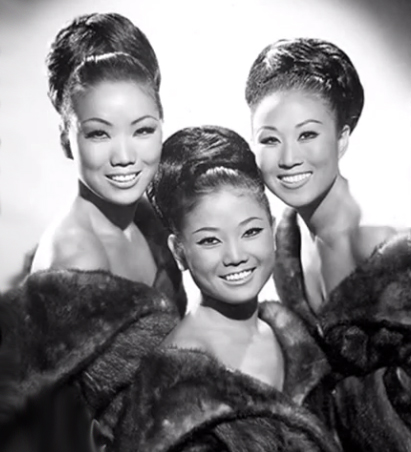
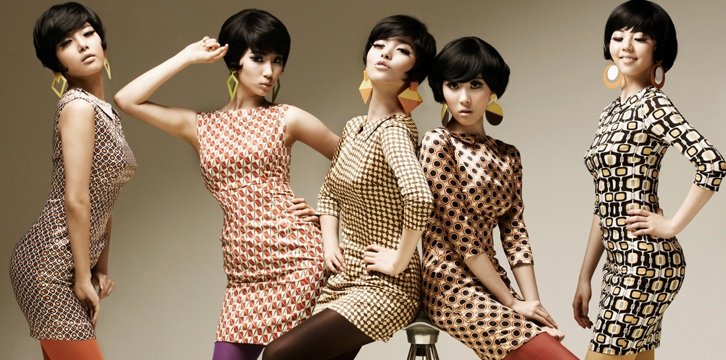
When K-pop adopts the 1960s retro look for female artists through chic hairstyles and dresses with eye-catching prints or dazzling sequins and fur reminiscent of The Supremes, I suggest that it partakes of a model of ethnic glamour established by black girl groups. Brian Ward characterizes Gordy’s quest for mainstream success as one predicated on challenging prevailing notions about American blacks: “Gordy felt [the training] might make them more acceptable to white America and an expanding black middle class for whom mainstream notions of respectability remained important” (266). The aspiration was felt by blacks, even those not in the middle class: “The spangled pursuit of success carried no stigma among black fans who had routinely been denied equal opportunity to compete for the financial rewards of the mainstream” (Ward, 267). This is key, because it shows the importance of how viewers read such images. Cynthia Cyrus argues that even though the images of girl groups of the 1960s were well-managed and carefully crafted, they nevertheless resonated positively with fans: “The girl group images offer affirmative messages about what it means to be female, messages about belonging, about possibilities for participation, about the possibility of success. . . . The role of the viewer is central to creating meaning, and the girl group fan engaged actively in dialogue with the images placed before here” (190-1).
Just as black fans interpreted those images of black women as positive, Korean women like the Kim Sisters, styled in the same way, represent a glamourous ethnic, in this case, Korean, experience to aspire to. Ian Kim writes: “For a Korean American like me, who grew up in parts of the US where I was the only Asian kid in school, it’s pretty astonishing to discover Korean performers who were successful in the US such an early time. Even more impressive is that they sang in English.” The Kim Sisters’ images and participation in the entertainment world in the United States functioned as an alternative to the realities of the aftereffects of the Korean War and American military presence. San Byun-Ho remembers: “After the Korean War, the Korean situation was the worst in the world; we were one of the poorest countries, like the Congo or somewhere like that. The country was devastated. A lot of people died” (Forsyth). Just like images of 1960s black girl groups, such images of the Kim Sisters represent an image of ethnic aspiration.
Contemporary fans may see retro images in K-pop, like those by Lee Hyori and the Wonder Girls, as drawing from a visual discourse of ethnic glamour. The measure of the impact of the image should also be measured by those who make meaning out of it. These images matter precisely because they show Koreans in a glamorous context that also acknowledges their ethnicity. As the Vintage Black Glamour Tumblr and forthcoming book suggest, images of ethnic glamour still resonate today. Nichelle Gainer says that any image she chooses has to have “a certain style to it, a certain beauty” and that she includes information about the photo because “I want people to know you’re not looking at some anonymous random person” (Brown). Given the frequency that the 1960s concept recurs in K-pop, ethnic glamour still matters.
Brown, Tanya Ballard. “‘Vintage Black Glamour’ Exposes Little-Known Cultural History.” The Picture Show – Photo Stories from NPR. NPR . 12 Oct 2012. Web. 27 Jan 2014.
Cyrus, Cynthia J. “Selling an Image: Girl Groups of the 1960s.” Popular Music 22.2 (2003): 173-193.
Early, Gerald. One Nation Under a Grove: Motown and American Culture. Ann Arbor: University of Michigan Press, 2012.
Forsyth, Luc. “Korea’s Stressed Masses.” Groove Korea. 20 Aug 2012. Web. 27 Jan 2014.
Kim, Ian. “The Kim Sisters.” Ian Kim. 23 Jan 2014. Web. 28 Jan 2014.
Lie, John. “What is the K in K-pop?: South Korean Popular Music, the Culture Industry, and National Identity.” Korea Observer 43.3 (2012): 339-363.
Belinda became a fan of Dong Bang Shin Ki (DB5K) because of their music, dancing and personality as seen in interviews. Her favorite song is the Korean version of “Love in the Ice.” Her favorite music video is “Mirotic.” She supports them by buying their music, going to concerts and maintaining her own blog. Her fan experience with DBSK has led to memories with her friends and other members of the fandom.
In addition to the case studies, the iFans project documents other mode of fan activity. The first section of the new exhibit, Dance Like Everyone’s Watching: K-pop Cover Dance, is up! Click HERE to view K-pop fans performing some of the most difficult K-pop dance routines.
Originally published on KPK: Kpop Kollective on February 8, 2014
The iFans project rolls on with more cover dance! The second section of the exhibit, Dance Like Everybody’s Watching: K-pop Cover Dances, features Girls’ Generation‘s “Into the New World Remix.” Click HERE to view K-pop fans from around the world performing one of the most complicated dance routines by a girl group.
Originally published on KPK: Kpop Kollective on February 14, 2014
Hallyu Harmony: A Cultural History of Kpop is a digital humanities project that traces connections among the artists and groups across genres, generations and geographies through visuals, music and choreography. The first exhibit, Seo Taiji: President of Culture, explores the reasons why Seo Taiji is considered the pioneer of contemporary K-pop. The current exhibit under construction, Move the Crowd: Choreography and K-pop, explores an other key aspect of K-pop: dance. APeace is the first page in the first section of this exhibit, Star Array: Dance and the Large K-pop Group. With 21 members, APeace is one of the largest K-pop groups. See how they use their numbers in choreography here.
As the number of female groups increase in number in K-pop, commentators and scholars continue to focus on the meaning of the representations produced by these groups. While some argue that such representations are geared towards men, this ignores the way the majority female fanbases of these groups construct meaning of these representations.
Because female groups, like many male groups in K-pop, are put together by Korean agencies (rather than forming on their own, as is the norm in countries like the United States in the West), some argue that appeal to men plays a role in this process. A guest contributor for seoulbeats asserted: “Like many other K-pop girl groups, SNSD [Girls’ Generation] was created to be ‘ogled’ over by their target audience–male fans.” This sentiment was repeated by other online writers such as James Turnbull and Jessica Doyle.
Scholars not only argue that groups like SNSD were created for men, they also argue that images, music videos and performances by girl groups like SNSD are targeted to male, middle-aged audiences. Through an examination of music videos and lyrics, Stephen Epstein with James Turnbull conclude that they all geared towards men rather than female empowerment, whether it is the “viewer. . . [who] is regularly constructed as male,” a mode of femininity “that renders males helpless,” “a self-objectifying preoccupation with an external gaze” or the definition of “women in relation to men” (333). In doing so, they challenge the notion that empowerment represented by girl groups “brings young women to a heightened sense of their own possibilities in the world” and conclude “that Korea’s pop culture commodification of sexuality has reached the point that for middle-aged men to focus on their gaze on underage performers becomes cause for rejoicing rather than embarrassment” (333).
However, several scholars have noted that the K-pop training model originally sought to ascertain the preferences of teenage girls. In separate articles, Doobo Shim and Solee I. Shin and Lanu Kim reference Lee Soo Man‘s survey of teenage girls to discover what they wanted in their first-generation idols at SM Entertainment. Since then, agencies continue to target audiences beyond middle-aged men. With the development of second-generation idols like SNSD, cross-generational appeal became the goal which includes audiences in addition to middle-aged men. Kim Chang Nam observes that “fandom has expanded to include people in their twenties and thirties, and even into older generations. Newly coined terms, including ‘uncle fans,’ ‘aunt fan,’ and ‘older sister fan,’ have appeared” (111). As a result, middle-aged men are one of a number of types of audiences for a group like SNSD.
Moreover, an interpretation of videos and lyrics overlooks how the majority female audience for girl groups like SNSD construct meaning about the images and performances they see. S. Craig Watkins and Rana Emerson draw on theories of media reception, which posit “that receivers of media are actively involved in the construction of meaning” (156). In doing so, they reveal not only “the strategic ways girls and women use the media in their everyday lives” but also “the ways in which women appropriate the media as a site of meaning construction, actively engaging in and, occasionally, contesting images and themes of gender domination” (157). As a result, they are not passive audiences, but actively create meaning for themselves based on what they see. Just because men may read such images in a way that does not empower women does not mean that female audiences read them in the same way.
This is not the first iteration of the girl group. Even when such images are created by men, as Cynthia Cyrus notes for images of 1960s girl groups, women can still craft meaning independent of the intention of such images:
Still, to understand these images primarily as symbols of male desire is to miss the point. The teen standing in front of the record bin would not have primarily engaged with the picture through some displaced sexual desire. Rather, she would have evaluated these images as what they were, invitations to consumer participation. The girl group images offer affirmative messages about what it means to be female, messages about belonging, about possibilities for participation, about the possibility of success. . . . Ethnographic evidence suggests that viewers did, in fact, identify with the girl group image (190-191).
Rather than one way of rendering meaning from girl groups, even female fans do not make the same kinds of meaning out of girl groups. The representations of femininity and female behavior are more complex than reducing them down to objects for men to look at. Such an approach silences the voices of the majority female fanbases who circulate, consume and make meaning of performances by girl groups.
Cyrus, Cynthia J. “Selling an Image: Girl Groups of the 1960s.” Popular Music 22.2 (2003): 173-193.
Epstein, Stephen with James Turnbull. “Girls’ Generation? Gender, (Dis)Empowerment, and K-pop.” The Korean Popular Culture Reader. Ed. Kyung Hyun Kim and Youngmin Choe. Durham: Duke University Press, 2014. 314-336.
Guest, “Is SNSD Being Sexually Harassed?” seoulbeats. 2 Mar 2010. Web. 3 May 2014.
Kim, Chang Nam. K-pop: Roots and Blossoming of Korean Popular Music. Seoul: Hollym, 2012.
Shim, Doobo. “Hybridity and the Rise of Korean Popular Culture in Asia.” Media, Culture & Society 28.1 (2006): 25-44.
Shin, Solee I and Lanu Kim. “Organizing K-pop: Emergence and Market Making of Large Korean Entertainment Houses, 1980-2010.” East Asia(2013): DOI 10.1007/s12140-013-9200-0.
Watkins, S. Craig and Rana A. Emerson. “Feminist Media Criticism and Feminist Media Practices.” Annals of the American Academy of Political and Social Sciences. 571 (2000): 151-166.
Visuals are an important part of K-pop, and understanding them is crucial to understanding the meaning of K-pop and its spread globally.
In addition to music videos, images that accompany promotions for music releases, photo shoots featured in magazines and endorsements for an array of products are seen, collected and exchanged by fans. Not just important fan activity, such archiving in the lay sense is important to the preservation and memory-keeping of the visual narrative of K-pop.
In addition to the promotional function they perform, K-pop images also perform cultural work, constructing multifaceted representations of Korean identity. Anne Anlin Cheng, professor of English and African American studies at Princeton University, sees “celebrity as a politics of recognition and glamour as a politics of personhood” (1023). This has special resonance for raced bodies:
Glamour’s imperviousness thus draws on a crisis of personhood that is inherently political and maybe even strangely liberating for a woman and a minority–liberating not in the simple sense of acquiring a compensatory or impenetrable beauty. . . but in the sense of temporary relief from the burdens of personhood and visibility. It may seem counterintuitive or even dangerous to talk about the raced and sexualized body’s longing to be thinglike or to disappear into things, but it is the overcorporealized body that may find the most freedom in fantasies of corporeal dematerialization or, alternatively, of material self-extension (1032).
In other words, the highly stylized images that pepper K-pop represent a visual construction of Korean identities, visuals of how Koreans project themselves globally. For ethnic people who have been constructed by others, such images are important because they do cultural work, deconstructing or altering images of Koreans and the ideas that accompany them.
I have started a new section in my digital humanities project, Hallyu Harmony, to document and curate images of K-pop groups and artists. In doing so, I hope to be able to make meaningful statements about the kinds of representations of Korean men and women that permeate K-pop, detecting patterns that become apparent when such images are collected together.
In the Visuals section of Hallyu Harmony, image galleries are organized into three broad categories:
Casual, images designed to appeal to everyone
Chic, images designed to represent more sophisticated styling attainable by most
Couture, images designed to capture more fantastic styling not designed for normal wear
Within these categories, images are further organized by concepts, magazine shoots and other promotional images. Concepts for music releases are placed in rough chronological order, allowing users to see how an artist or group’s image evolves over time.
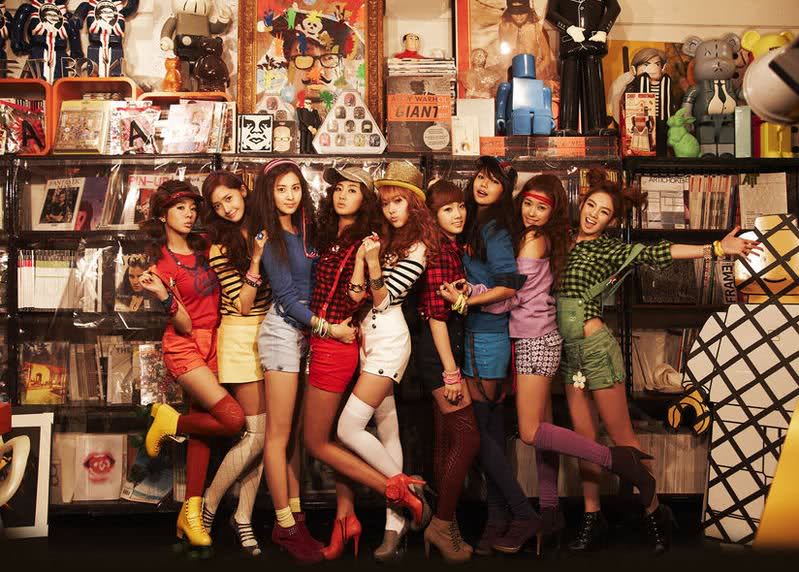
The image gallery for Girls’ Generation, shows a greater variety of images than their reputation may suggest. A review of their concepts show that they are equally likely to promote a casual, chic or couture image. However, they are less likely to reflect a couture image in photo shoots for magazines. On the other hand, early observations of 2NE1’s image gallery (in progress) suggest that even though the group is known for its fierce reputation and image that many fans can relate to, the group reflect a chic image for many concepts.
2NE1, Falling in Love Concept, 2013
SNSD, Ceci Magazine, 2009
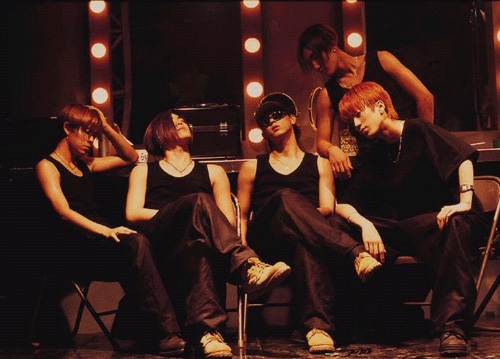
Documenting such images presents challenges. Many images gathered from the Internet are divorced from their original context as they are shared by fans and K-pop media. As a result, tracing an image’s origins is not always possible. In some cases, the availability of images within their context is related to the commitment of Korean agencies to preserve the context of images. For example, the H.O.T image gallery (in progress) features many images, but few that can be placed in their original context. SM Entertainment‘s sites do not provide information for images on its H.O.T site. On the other hand, many of the concept images in S.E.S.’s image gallery can be associated with their original context due to the continued access to the group’s SM site. Other sites, like DSP Media (formerly DSP Entertainment) only includes current artists on its website, so locating images for Fin.K.L‘s image gallery (in progress) will be challenging. Images will have to be obtained from other sources. Moreover, it is easier to document 2nd and 3rd generation K-pop groups and artists like SNSD, while first generation groups like H.O.T and S.E.S prove more challenging because the groups are not active.
H.O.T
S.E.S
However, their fanbases are. Fan sites provide the bulk of the images documented, thus acting as valuable informal archives. As more image galleries are completed, I hope to write about the patterns that emerge from images from individuals and groups and compare them with other K-pop artists.
Often believed to appeal only to teenagers, K-pop is experiencing a trend with old school groups making successful comebacks.
Some believe that K-pop has a short shelf life. Several point to the “five-year curse,” a trend where male K-pop groups break up or disband, often in the face of mandatory military service in Korea. Others believe that K-pop is a fad that will run its course. In 2011, Ree at seoulbeats declared: “One thing people must note when discussing the popularity of K-Pop, is that to many people, whether they realize it or not, K-Pop has almost simply become a fad. Meaning that despite the fact it is at its peak of popularity, it will once again start heading on a downhill slope.”
However, successful comebacks of groups who debuted prior to 2000 challenge these notions. Tickets for Shinhwa‘s Grand Tour 2012: The Return concert sold out in February, ahead of the release of the album The Return in March. Such success occurred after a four-year hiatus by group from the music scene. Other first-generation K-pop groups, such as g.o.d and Fly To the Sky, have also announced comeback plans.
Who are the people who support groups who have been inactive for years and why do they continue to like such groups? I want to find out! If you are a fan of a group who debut before 2000, take this survey! It will ask you questions about old school K-pop groups such as H.O.T, Shinhwa, S.E.S, Fin.K.L, Fly to the Sky, g.o.d, 1TYM, Deux and others.











 csaphd | Crystal S. Anderson