Ever so often, someone writes a piece criticizing assessment in higher education. While a process like reaccreditation is a beast, some criticisms of it overlook the value of reviewing our courses and articulating what students should learn from them.
In Part 1, I considered student learning outcomes, the foundation of good course design, and how they relate to my learning goals in teaching Korean popular culture. In Part 2, I cover how I determine to how to evaluate what students know or can do by the end of the course (assessments) as well as the kind of activities that would help them develop the knowledge and skills they would need (assignments).
I cannot stress enough that if you are teaching your course online, in a hybrid scenario or face to face, you are still teaching in a pandemic. This means flexibility will be key to managing unforeseen circumstances can impact you and your student’s engagement in your course. Such circumstances can include your students being quarantined or getting sick, or someone they live with experiencing the same. We can design our courses to be rigorous and address such disruptions. I try to keep this in mind when thinking about assessment and assignments in my course. Don’t be so hard on yourself to design the perfect course either. Remember, we’re in a pandemic, y’all. Your class is going to be good because you have a wealth of information and your sparkling personality.
Let’s start with assessments. My highest-order thinking goal is for students to analyze Korean popular culture. I’m going to measure how well students can do this by having them write a long-form web article (1500-2000 words) where they use scholarly concepts to interpret multimedia sources. This is the major assessment of the course. The rubric (later post!) that I will develop will ascertain how well students do such things as articulate a thesis, use sources as evidence and create a well-supported argument.
But before students can do any of these, I’ll have to teach them and give them practice. This is where assignments come in. We also call them learning support tasks. They are basically anything that helps students acquire fundamental knowledge and skills necessary for later higher-order thinking. They are low-stakes assignments, worth a few points in a student’s overall grade, and cover a small portion of a larger assignment.
I start using these assignments in week 1. Students choose their own topics on the first day of class, so they will be motivated because they are able to focus on things that interest them. K-pop cover dance your jam? Have at it. Down with K-drama? Cool. Every other week they will post and talk about sources they find related to that topic so they are regularly engaged with their topic and sources.
In addition, students will write short-form articles (200-250 words) every other week. They are worth 2% each and are always on the student’s topic. The short-form articles are also cumulative. For example, for the first one, I students focus on just crafting a main, controlling idea. The next one, in addition to crafting a main, controlling idea, they also focus on using sources to support the argument. You get the idea. Because they are low-stakes, they give students the opportunity to develop knowledge and skills without worrying about mistakes costing them in terms of their grade. They are also motivated because they are following their interests. Not only are these low-stakes assignments connected to each other, they also form the foundation for the long-form web article. The long-form article represents an extension of the writing they do for the short-form assignments, so that towards the latter part of the class, they are largely focused on revision.
Normally, students would have probably 6 of these short form writing assignments. For this course, I reduced the number to 4 and focused each one on just the most important things I wanted students to be able to do. For example, normally I focus on having students do research with scholarly sources. However, this is not a research class, and I’m more interested in having students apply certain scholarly concepts to examples they encounter in Korean popular culture. So I spend more time making sure they can apply the concepts to music and music video, K-drama and film than finding scholarly sources. That type of scholarly research is not part of my student learning outcomes. Coco Chanel once said: “Before you leave the house, look in the mirror and take one thing off.” Similarly, I looked at my syllabus and ended up taking out several assignments. I realized that some assignments were redundant. I found I could combine others because they were doing similar work towards my student learning outcomes. Less is more. I feel my course still covers a good range of material and challenges students.
Finally, I considered how I can make this setup work in a pandemic. To anticipate disruptions in students’ lives, I will drop the lowest grade for short-form writing assignment. I will also provide copious opportunities for extra credit. This can ease students’ anxiety over getting sick or having to be out for at least two weeks. This way, students do not have to worry and can do their best when they can do their best. This may feel strange for some people because they have an idea in their heads about how their course should go. But when your course is well-aligned, it can reduce anxiety because everything is centered around what students will learn. At the same time, you can still have some spontaneity in your course. Discussions can be unpredictable. Student choices about topics will run the gamut. And if something isn’t working, feel free to change it on the fly.
Designing your course with assignment and assessments that are linked to your student learning outcomes and anticipating disruption will help you tremendously in the coming semester.
Before deciding on all the cool content to include in my course, KORE 320: Korean Popular Culture, there is one thing that I had to do, something that forms the foundation of the course. Figuring out this one thing made designing the course easier and will make for more effective learning for students. It was not readings, content, assignments or assessments. The one thing I needed to decide was: What do I want students to know or be able to do by the end of the course?
In other words, it was the dreaded student learning outcomes. Look, I get it. Most faculty first encounter student learning outcomes as part of program assessment or curricular development, and it’s not fun. Within these contexts, it seems very formulaic and disconnected from student learning. But the fact of the matter is, knowing what you want students to know and do by the end of the course helps you to align everything else: readings, assignments and assessments. This means that everything has a purpose in the course. Students appreciate this because nothing is busywork.
In my KORE 320 course, I’m focusing on using Korean popular culture to teaching students about digital literacy, digital curation and digital writing because most of us outside of Korea engage with Korean popular culture through digital means. Students will learn how to locate and evaluate online media, describe the development and global spread of Korean popular culture, use scholarly concepts to interpret Korean popular culture and develop skills through the use of digital, web-based tools.
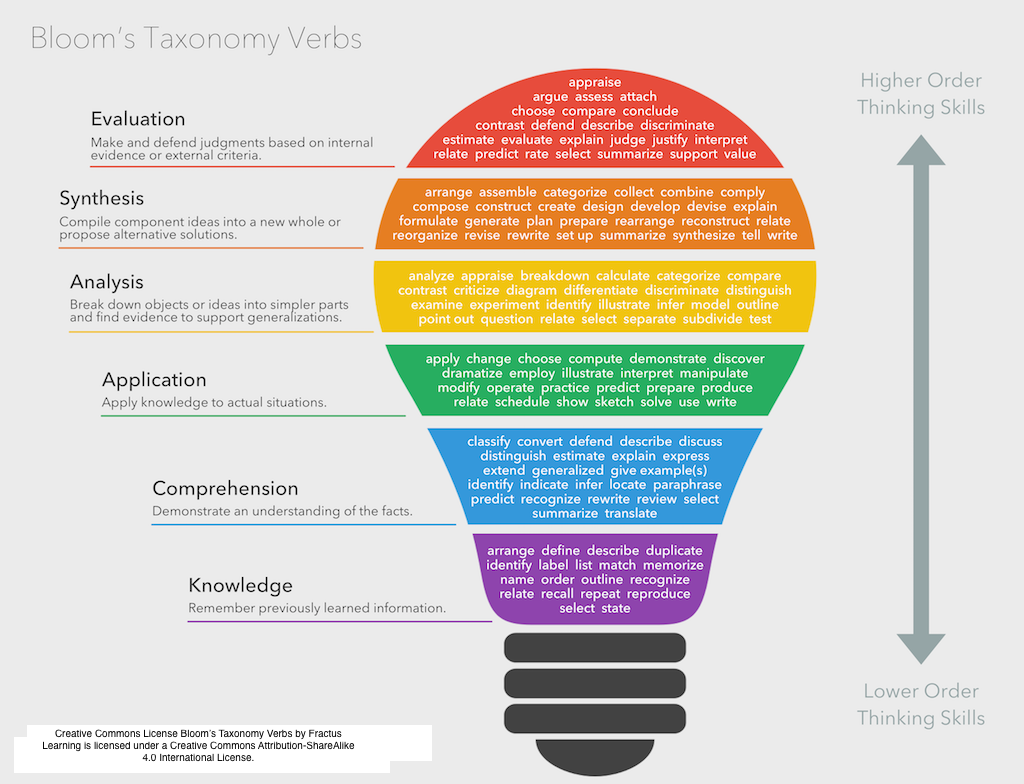
While they look concise, coming up with my learning outcomes wasn’t easy. I spent weeks honing them. Why? Because I had to make sure that before students did advanced things (known in HE circles as higher-order thinking) they had opportunities to work up to them (by doing lower-order thinking). Cue Blooms Taxonomy!
Image: Fractus Learning
For example, I want students to be able to analyze Korean popular culture (higher-order thinking). But before they can do that, I have to give them the opportunity to be able to define concepts that can be used to analyze Korean popular culture (lower-order thinking) and provide opportunities for them to practice applying those concepts to Korean popular culture (midway between lower-order and higher-order). I have some nifty ideas about getting my students to do this (future post), and as fun as it is to start with the readings or the historical and cultural context or the videos or the dramas, I needed to work this out first. As instructors, student learning outcomes help us to map out how learning happens in our courses and create well-designed courses. Other factors can also inform your decisions. Where does the course fall in the curriculum? Is it required or an elective? Are there program outcomes it needs to meet? Is it a general education course? These can shape how you craft your outcomes.
One thing you’ll notice quickly is that you may not be able to cover as much breadth as you’d like. I know, I know, you want to do all the things. I could teach this whole course on 2nd generation K-pop idols. But, there is a good amount of research that suggests that depth is beneficial for student learning. How many times have you taught a course and had to cut material? How sure were you that students did all that reading? Depth gives students the tools they need to encounter ideas they may encounter beyond your material.
When a course is well-designed, then it is easier to know how it might be able to change to address shifting circumstances, like changing modalities (future post) because of a pandemic. Notice this post does not start out with the modality of teaching (i.e. face-to-face, hybrid, online), because that’s not the most important thing. If you know your outcomes and how you will measure them (future post), then it is easier to change modalities because the foundation of your course is set.
Spending some time crafting your outcomes will lay a solid foundation for your course.



 csaphd | Crystal S. Anderson