
Teaching K-pop, Part 2: Assignments and Assessments (ew!)

Image by Peter H from Pixabay

In Part 1, I considered student learning outcomes, the foundation of good course design, and how they relate to my learning goals in teaching Korean popular culture. In Part 2, I cover how I determine to how to evaluate what students know or can do by the end of the course (assessments) as well as the kind of activities that would help them develop the knowledge and skills they would need  (assignments).

I cannot stress enough that if you are teaching your course online, in a hybrid scenario or face to face, you are still teaching in a pandemic. This means flexibility will be key to managing unforeseen circumstances can impact you and your student’s engagement in your course. Such circumstances can include your students being quarantined or getting sick, or someone they live with experiencing the same. We can design our courses to be rigorous and address such disruptions.  I try to keep this in mind when thinking about assessment and assignments in my course. Don’t be so hard on yourself to design the perfect course either. Remember, we’re in a pandemic, y’all. Your class is going to be good because you have a wealth of information and your sparkling personality.

Let’s start with assessments.  My highest-order thinking goal is for students to analyze Korean popular culture.  I’m going to measure how well students can do this by having them write a long-form web article (1500-2000 words) where they use scholarly concepts to interpret multimedia sources.  This is the major assessment of the course.  The rubric (later post!) that I will develop will ascertain how well students do such things as articulate a thesis, use sources as evidence and create a well-supported argument.

But before students can do any of these, I’ll have to teach them and give them practice. This is where assignments come in. We also call them learning support tasks.  They are basically anything that helps students acquire fundamental knowledge and skills necessary for later higher-order thinking. They are low-stakes assignments, worth a few points in a student’s overall grade, and cover a small portion of a larger assignment.

I start using these assignments in week 1. Students choose their own topics on the first day of class, so they will be motivated because they are able to focus on things that interest them. K-pop cover dance your jam? Have at it. Down with K-drama? Cool. Every other week they will post and talk about sources they find related to that topic so they are regularly engaged with their topic and sources.

In addition, students will write short-form articles (200-250 words) every other week.  They are worth 2% each and are always on the student’s topic. The short-form articles are also cumulative. For example, for the first one, I students focus on just crafting a main, controlling idea. The next one, in addition to crafting a main, controlling idea, they also focus on using sources to support the argument. You get the idea. Because they are low-stakes, they give students the opportunity to develop knowledge and skills without worrying about mistakes costing them in terms of their grade. They are also motivated because they are following their interests. Not only are these low-stakes assignments connected to each other, they also form the foundation for the long-form web article. The long-form article represents an extension of the writing they do for the short-form assignments, so that towards the latter part of the class, they are largely focused on revision.

Normally, students would have probably 6 of these short form writing assignments. For this course, I reduced the number to 4 and focused each one on just the most important things I wanted students to be able to do. For example, normally I focus on having students do research with scholarly sources. However, this is not a research class, and I’m more interested in having students apply certain scholarly concepts to examples they encounter in Korean popular culture. So I spend more time making sure they can apply the concepts to music and music video, K-drama and film than finding scholarly sources.  That type of scholarly research is not part of my student learning outcomes. Coco Chanel once said: “Before you leave the house, look in the mirror and take one thing off.”  Similarly, I looked at my syllabus and ended up taking out several assignments. I realized that some assignments were redundant. I found I could combine others because they were doing similar work towards my student learning outcomes.  Less is more. I feel my course still covers a good range of material and challenges students.

Finally, I considered how I can make this setup work in a pandemic.  To anticipate disruptions in students’ lives, I will drop the lowest grade for short-form writing assignment. I will also provide copious opportunities for extra credit. This can ease students’ anxiety over getting  sick or having to be out for at least two weeks. This way, students do not have to worry and can do their best when they can do their best. This may feel strange for some people because they have an idea in their heads about  how their course should go. But when your course is well-aligned, it can reduce anxiety because everything is centered around what students will learn. At the same time, you can still have some spontaneity in your course. Discussions can be unpredictable. Student choices about topics will run the gamut. And if something isn’t working, feel free to change it on the fly.

Designing your course with assignment and assessments that are linked to your student learning outcomes and anticipating disruption will help you tremendously in the coming semester.

Creative Commons License
Teaching K-pop, Part 2: Assignments, Assessments (ew!) and Modalities by Crystal S. Anderson is licensed under a Creative Commons Attribution-NonCommercial 4.0 International License.


Teaching K-pop, Part 1: The Most Important Thing

Image by Simone Lugli from Pixabay

Before deciding on all the cool content to include in my course, KORE 320: Korean Popular Culture, there is one thing that I had to do, something that forms the foundation of the course. Figuring out this one thing made designing the course easier and will make for more effective learning for students. It was not readings, content, assignments or assessments.  The one thing I needed to decide was: What do I want students to know or be able to do by the end of the course?

In other words, it was the dreaded student learning outcomes. Look, I get it. Most faculty first encounter student learning outcomes as part of program assessment or curricular development, and it’s not fun. Within these contexts, it seems very formulaic and disconnected from student learning. But the fact of the matter is, knowing what you want students to know and do by the end of the course helps you to align everything else: readings, assignments and assessments. This means that everything has a purpose in the course. Students appreciate this because nothing is busywork.

In my KORE 320 course, I’m focusing on using Korean popular culture to teaching students about digital literacy, digital curation and digital writing because most of us outside of Korea engage with Korean popular culture through digital means. Students will learn how to locate and evaluate online media, describe the development and global spread of Korean popular culture, use scholarly concepts to interpret Korean popular culture and develop skills through the use of digital, web-based tools.

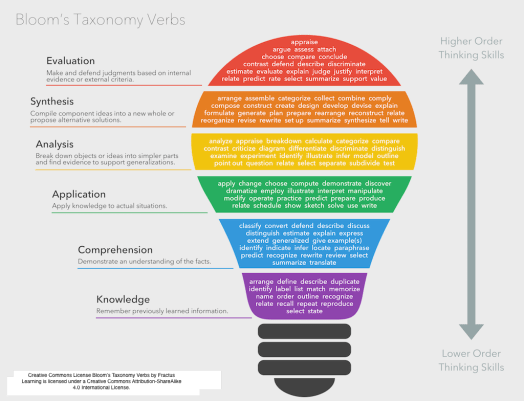
While they look concise, coming up with my learning outcomes wasn’t easy.  I spent weeks honing them. Why? Because I had to make sure that before students did advanced things (known in HE circles as higher-order thinking)  they had opportunities to work up to them (by doing lower-order thinking). Cue Blooms Taxonomy!

Image: Fractus Learning

For example, I want students to be able to analyze Korean popular culture (higher-order thinking). But before they can do that, I have to give them the opportunity to be able to define concepts that can be used to analyze Korean popular culture (lower-order thinking) and provide opportunities for them to practice applying those concepts to Korean popular culture (midway between lower-order and higher-order). I have some nifty ideas about getting my students to do this (future post), and as fun as it is to start with the readings or the historical and cultural context or the videos or the dramas, I needed to work this out first. As instructors, student learning outcomes help us to map out how learning happens in our courses and create well-designed courses. Other factors can also inform your decisions. Where does the course fall in the curriculum? Is it required or an elective? Are there program outcomes it needs to meet? Is it a general education course? These can shape how you craft your outcomes.

One thing you’ll notice quickly is that you may not be able to cover as much breadth as you’d like. I know, I know, you want to do all the things. I could teach this whole course on 2nd generation K-pop idols. But, there is a good amount of research that suggests that depth is beneficial for student learning.  How many times have you taught a course and had to cut material? How sure were you that students did all that reading? Depth gives students the tools they need to encounter ideas they may encounter beyond your material.

When a course is well-designed, then it is easier to know how it might be able to change to address shifting circumstances, like changing modalities (future post) because of a pandemic. Notice this post does not start out with the modality of teaching (i.e. face-to-face, hybrid, online), because that’s not the most important thing. If you know your outcomes and how you will measure them (future post), then it is easier to change modalities because the foundation of your course is set.

Spending some time crafting your outcomes will lay a solid foundation for your course.

Creative Commons License
Teaching K-pop, Part 1: The Most Important Thing by Crystal S. Anderson is licensed under a Creative Commons Attribution-NonCommercial 4.0 International License.
What K-pop Can Teach Us About Engagement for Online Courses

Image by Gerd Altmann from Pixabay

One of the most common concerns about moving courses online is that engagement is lost. However, it could be useful to draw on the kind of engagement that is central to contemporary Korean popular music (K-pop) culture.

Most articles you may read about the need to teach online courses (as opposed to the emergency remote teaching that most instructors engaged in in the spring) contains the often unchallenged assertion that online courses cannot replicate the engagement of the face-to-face course, seen by many as indispensable to learning.  John Kroger recently wrote in Inside Higher Education: “In the process, we have gained a much clearer understanding of what online education cannot do — or, in other words, the ways in which traditional in-person cannot be replaced. The most obvious area in which online delivery simply cannot replicate the value of in-person learning is in science and technology education. ” For many, this extends to other disciplines as well. Many people believe that being face-to-face is essential to learning. Period. Related to this critique is the characterization of online courses. Drawing on their experience this past spring or bad online course experiences, some argue that online courses are merely videos and quizzes.

We know that learning is a social activity. Instead of trying to replicate the face-to-face experience, we might look to modes of engagement that already work online. K-pop artists and fans have used the digital space to form connections and have engaging and memorable interaction for years. K-pop artists use social media such as Twitter, Instagram, VLive and YouTube to communicate with fans and share content. Fans reciprocate, as evidenced by the large numbers of followers artists have on these outlets. From old-school sharing platforms like MediaFire to closed discussion forums to collaborative Twitter accounts, K-pop fans have been deploying social media to communicate with each other for years.  This was particularly the case in the early years of the global spread of K-pop. If you were a fan of K-pop, it was unlikely that you knew anyone in your real life who was also a fan. As a result, fans turned to the internet. And while many people negative characterize K-pop fan activity,  fans more often deploy online modes to collaborate on philanthropic projects, organize promotion support and just engage with each other over a common passion.  K-pop fans often talk about the bonds they form with other fans without ever having met them.

Instructors could use these platforms in their courses to support the kind of engagement that is crucial for learning.  How can we create opportunities for students to create community in our courses? Do we have a space where students can post things they find related to the course and learn to look at such artifacts critically? Do we provide a way for students to talk to each other? Do we encourage students to form chat groups with other members of class for that important back-channel back-and-forth? Do we limit our interaction with students to just sharing information and content from the course, or can we envision a space in our online course where we just chit-chat with students?

When I mentioned this to a colleague, he responded that people spend untold hours watching YouTube or on Twitter because it is something they like. Could this be the real crux of the challenge facing instructors in the move to online, namely, to make our courses interesting enough for students to spend the kind of time on them as they spend in other activities on the Internet?

Sources

John Kroger. “The Limits of Online Education.” Inside Higher Education. 6 May 2020. https://www.insidehighered.com/blogs/leadership-higher-education/limits-online-education (14 May 2020).

Creative Commons License
What K-pop Can Teach Us About Engagement for Online Courses by Crystal S. Anderson is licensed under a Creative Commons Attribution-NonCommercial 4.0 International License.

Engaging Engagement in Online Courses

Image by Gerd Altmann from Pixabay

In discussions about remote learning and future online teaching that many educators may face in the fall, concerns about engagement dominate. They often include the unchallenged claim that online instruction cannot replicate the engagement found in face-to-face teaching. But is that true?

Many erroneously equate the emergency online teaching that most institutions relied on this spring with the kind of online teaching many institutions may be considering for the fall. As a result, they often claim that online teaching generally fails to engage the student as face-to-face classes and result in actual learning. Students have expressed attitudes that the remote education they received during the pandemic has failed them. Commentators on education, like Jonathan Zimmerman, equate most modes of online education to the early days of educational TV, declaring that “Real conversation happens when people are in the same room, not when they’re on the same channel” and “Social distancing is necessary to preserve good health, but it’s not good for education.” Both students and educators point to engagement as a crucial part of the teaching and learning experience and assume it is lacking in online education.

However, we shouldn’t assume that engagement occurs just because student and instructors are in the same room or that one cannot achieve such engagement in an online course. Stephanie Moore and Phil Hill point to the substantial scholarship on the effectiveness of online learning compared to classroom-based learning: “What these studies show, time and again, is no significant difference. In fact, this has been labeled the ‘no significant difference phenomenon’ with a website and book by Thomas Russell (2001) dedicated to documenting the studies and the trend.”

What can make a difference in effective teaching in both settings? Actively engaging students in the course material, with the instructor and with each other. IU – Teaching Online notes that:

The concept of active learning encompasses a wide variety of learning activities in which students engage with the course content. The focus of active learning is to foster that engagement. When students sit and passively watch or listen to lectures – whether in person or on video – they are not actively engaging with the content.

We also know that students learn more effectively when they are involved in their own learning. A cursory look at activity on the Internet and social media reveals that we can have a high level of engagement in an online environment. Individuals spend hours engaging with each other, learning how to do a variety of things. Moreover, I know from personal experience that it is possible to involve students in collaborative research on the Internet. We should view the current situation as an opportunity to develop our best teaching to achieve a similar level of engagement for fall courses that may be online.

Sources

Jonathan Zimmerman. “Video Kills the Teaching Star.” The Chronicle of Higher Education. 24 Apr 2020. https://www.chronicle.com/article/Video-Kills-the-Teaching-Star/248631?cid=wcontentgrid_41_5 (Accessed 5 May 2020).

“Learning Activities and Active Learning Online.” IU – Teaching Online, UC-Davis, n.d., https://canvas.ucdavis.edu/courses/34528/pages/learning-activities-and-active-learning-online?module_item_id=4973 (5 May 2020).

Stephanie Moore and Phil Hill. “Planning for Resilience, Not Resistance.” Phil On EdTech. 28 Apr 2020.  https://philonedtech.com/planning-for-resilience-not-resistance/  (Accessed 5 May 2020).

Creative Commons License
Engaging Engagement in Online Courses by Crystal S. Anderson is licensed under a Creative Commons Attribution-NonCommercial 4.0 International License.

Mission Impossible: Curating the History of K-pop

Some of us are using this unprecedented time to work on projects that have gotten away from us. My latest project, KPOPCULTURE, a never ending quest to create a history of K-pop, is one such project!

From KPOPIANA to the Kpop Collaboration Project, I have been working on projects that seek to document and describe K-pop’s development, structure and how we think about it. Such research is the essence of a mission impossible research project, one that relies on ever-shifting sources on K-pop on the Internet and constant development of the music in general. But most importantly, it’s a challenge doing this work for 10 years, especially in the early years when K-pop was not even recognized as a legitimate object of study.  But research is not dependent on what’s popular and trendy; it’s driven by curiosity.

Working with undergraduate students, my colleague Kaetrena Davis Kendrick and I trained students (and pretty anyone else, really) back in 2011 to use digital tools to find and evaluate key information about K-pop and its culture using our KPK: KPopKollective site housed on good old WordPress. Our Kpop Essentials defined common terms used by K-pop fans, while Solo Artists and Groups provided basic information (like explanation of fandom names!), discographies and videographies.   We moved this project over to KPOPIANA, and used its more robust tools to document more extensive information.

At the core of such projects has always been curation and documentation. As my historian friends will tell you, it’s not just about information; it’s about crafting a narrative based on observing patterns, influence and relationships. This means not only going through a lot information, but putting that information in a form that explains and seeks to answer not just what but also why.

Which brings me back to KPOPCULTURE, my most adventurous project to date to capture a comprehensive history of K-pop. Housed in Omeka, a web-based content management system, KPOPCULTURE allows me to document and explain K-pop’s music, choreography, creative personnel and media. The project balances providing information to the public with more in-depth context-building to understand K-pop artists, the industry and the media.

For example, Omeka allows me to create items with more discrete information, like capsule profiles on artists like TVXQ, a group that recently had been deemed under-appreciated and little-known by current K-pop fans. Basics Items includes information about the K-pop artist as well as a selection of music videos that covers the breadth of a career. Omeka also allows me to use Items in Music Exhibits, such as SHINee: Like a Fire, a music exhibit that chronicles the group’s music through a curated playlist, music reviews and fan playlists. I have also created Special Exhibits, such as a retrospective of concepts used by Girls’ Generation (SNSD) in the exhibit, Girls’ Generation: Flower Power.

The quest continues! Let’s hope I can get more Items and Exhibits done.

Image by MasterTux from Pixabay

Creative Commons License
Mission Impossible: Curating the History of K-pop by Crystal S. Anderson is licensed under a Creative Commons Attribution-NonCommercial 4.0 International License.

How to Grade Faster and Foster Student Learning

Image: Pixabay

Grading is an age-old source of frustration for instructors, with many feeling torn between evaluating student performance and fostering student learning, as they struggle with less time to do either. However, one does not have to forgo student learning to attain more efficiency in grading.

In her piece “How to Grade Faster in 2020,” Deborah J. Cohan suggests that instructors can begin to grade more efficiently by limiting the number of assignments and increasing the value of those assignments for the final grade:

I don’t see the point in assigning a lot of busy work or many assignments each worth 1 percent to 10 percent and then feeling breathless all semester with grading.

Such advice may reduce grading for the instructor, but it runs counter to what we know about student learning. In “Want to Reach All of Your Students? Here’s How to Make Your Teaching More Inclusive,” Viji Sathy and Kelly A. Hogan explain the benefits of reducing high-stakes assignments: “When a single exam or paper carries a lot of weight, you risk letting that one experience or day wreak havoc on a student’s grade.”

One way to address the needs of both the instructor and the student is to consider the relationship between grading and feedback. Jeffrey Schinske and Kimberly Tanner explain that grading is a form of feedback that may be evaluative, which “judges student work [thorough grades, praise or criticism]”, or formative or descriptive, which “provides information about how a student can become more competent.”  Descriptive feedback can have a positive effect on evaluative feedback:

[One study found] that students receiving descriptive feedback (but not grades) on an initial assignment performed significantly better on follow-up quantitative tasks and problem-solving tasks than did students receiving grades or students receiving no feedback. (Schinske and Tanner).

Student learning is enhanced when instructors provide feedback meant to improve a student’s performance. There are several strategies that instructors can employ to provide this kind of descriptive feedback to students that, in the long run, will reduce the amount of evaluative feedback they provide.

Instructors can design courses in ways that provide feedback for low-stakes assignments through quizzes and other assessments. This means that instructors want to intentionally deploy these when they help students the most. Sathy and Hogan note that whatever low-stakes assignments an instructor chooses, it should be required: “When assignments are optional, compliance will vary and you risk exacerbating differences in study skills, background knowledge and the like.”

Holly Fiock and Heather Garcia suggest using technology, especially audio and video comments, to provide feedback that is frequent, specific, balanced, and timely. While Cohan discontinued her use of rubrics, a rubric directly linked to what the instructor wants students to be able to do, explained to students beforehand and coupled with time to practice is more effective. Fiock and Garcia note that rubrics and peer review help provide the kind of formative feedback that help enhance student learning, improve their performance and lessen the time it takes to provide evaluative feedback down the road.

For example, I used a series of low-stakes assignments that fed into the larger project for the literature class I taught in Fall 2019, “Worldbuilding in Science Fiction.” All of these assignments followed the same format:

  1. students created a draft before class and brought it to class
  2. students worked in groups to receive feedback from their peers
  3. students wrote down all of the feedback they received and then explained why they did or did not use the feedback
  4. students revised the draft, then turned in a document that contained the draft, the feedback, their response to feedback and the revision

I graded the assignments using a simple rubric where I looked for whether students had the elements of the assignments. I reviewed the feedback they received from their peers (they were using the same rubric) and made notes of the common mistakes students made. In most cases, a student’s revision was vastly improved from the draft, so I didn’t have to give feedback on the things group members had already addressed. In the next class, I went over with the class the common mistakes and show them how to improve for next time.

We can improve our grading efficiency in ways that do not diminish student learning.

Sources

Cohan, Deborah J. “How to Grade Faster in 2020.” Inside Higher Education. 11 Feb 2020, https://www.insidehighered.com/advice/2020/02/11/advice-grading-more-efficiently-opinion.

Fiock, Holly and Heather Garcia. “How to Give Your Students Better Feedback With Technology.” The Chronicle of Higher Education. 08 Nov 2019. https://www.chronicle.com/interactives/20191108-Advice-Feedback#2.

Sathy, Viji and Kelly A. Hogan. “Want to Reach All of Your Students? Here’s How to Make Your Teaching More Inclusive.” The Chronicle of Higher Education, 22 Jul 2019, https://www.chronicle.com/interactives/20190719_inclusive_teaching.

Schinske, Jeffrey and Kimberley Tanner. Teaching More by Grading Less (or Differently). CBE Life Sciences Education. 13.2 (2014): 159-166. doi: 10.1187/cbe.CBE-14-03-0054.

Creative Commons License
How to Grade Faster and Foster Student Learning by Crystal S. Anderson is licensed under a Creative Commons Attribution-NonCommercial 4.0 International License.

Disciplines and Active Learning

Image: Pixabay

Active learning represents a significant set of strategies that can increase student engagement with course material. However, how does disciplinary context factor into the way we use these strategies?

Active learning remains a major trend in higher education. Several of the most-read topics for The Chronicle of Higher Education‘s Teaching Newsletter revolved around active learning strategies, including the interactive lecture, test review and debriefing. Studies show that it can have a major impact on student learning. However, much of that research focuses on the implementation of active learning strategies in STEM courses. They represent a stark departure from the continuous lecture, a common mode of teaching, particularly in large classes.

For example, Scott Freeman and his colleagues conducted an analysis of 225 studies and found that active learning increased test scores, but this was specifically for undergraduate STEM courses: “The data suggest that STEM instructors may begin to question the contained use of traditional lecturing in everyday practice, especially in light of recent work indicating that active learning confers disproportionate benefits for STEM students from disadvantaged backgrounds and for female students in male-dominated fields” (8413).

However, disciplines in the humanities have employed active learning strategies like flipped learning for decades: “Procedurally, a humanities seminar is already ‘flipped.’ Exciting student interactivity in a ‘flipped’ engineering class is true of an ordinary humanities seminar” (Berens). So are active learning strategies only effective for certain disciplines? How can we make them effective in all disciplines?

Rather than a magic bullet, it may be more helpful to see active learning as a constellation of strategies that instructors link to the specific learning goals for their courses and match to the needs of their students. In doing, the disciplinary context is key. Some strategies work better than others for certain disciplines. Failing to link the strategies with student learning outcomes, student work and assessment could result in the failure of active learning strategies in the classroom. Claire L. Jarvis reports on Amanda Holton’s experience in her chemistry course at the University of California, Irvine:

Amanda Holton encountered the gap between the optimistic literature and reality when she flipped her large general chemistry class. . . . [Holton’s students] were in their first semester of college, nonmajors taking general chemistry as a prerequisite for their biology degrees. They weren’t strongly motivated to study chemistry and resented having to run through lectures and teach themselves outside the classroom. Exam performance only slightly improved compared with students who took the nonflipped version the year before.

It sounds like Holton’s flip could more directly address the kinds of students in her general course who, unlike majors, do not exhibit the same kind of motivation. Could Holton incorporate other activities that could spark their interest, perhaps linking chemistry to the world they experience everyday? Could she explain her use of the flipped classroom in a way that students see themselves participating in their own learning rather than being completely responsible for it?

Success with active learning strategies begins with the instructor intentionally incorporating and linking them to the goals of the course. Instructors are better positioned to get the most out of active learning when they keep disciplinary values in view.

Sources

Berens, Kathi Inman. “Double Flip: 3 Insights Flipping the Humanities Seminar.” Hybrid Pedagogy, 23 Jan 2014, https://hybridpedagogy.org/double-flip-3-insights-flipping-humanities-seminar/ (31 Jan 2020).

Freeman, Scott; Eddy, Sarah L; McDonough, Miles; Smith, Michelle K.; Okoroafor, Nnadozie; Jordt, Hannah and Mary Pat Wenderoth. “Active Learning Increases Student Performance in Science, Engineering, and Mathematics.” PNAS, 111.23 (2014): 8410-8415. doi/10.1073/pnas.1319030111.

Jarvis, Claire L. “The Flip Side of Flipped Classrooms: Popular Teaching Method Doesn’t Always Work as Planned.” C&EN, 17 Jan 2020, https://cen.acs.org/education/undergraduate-education/flip-side-flipped-classrooms/98/i3, (31 Jan 2020).

Labor from Below: What Neoliberal Capitalism Overlooks in K-pop (from KPK: Kpop Kollective)

Scholars frequently use the neoliberal capitalism frame to contextualize K-pop within the Korean wave, but the over-reliance on critiquing capitalist forces further silences the creative personnel of K-pop. If we approach K-pop using the “history from below” framework, we can reveal the perspectives of the individuals in the industry.  Read original at KPK: Kpop Kollective!

PROJECT UPDATE: The Music of SHINee

The Music of SHINee is a digital exhibit, part of the digital humanities project KPOPCULTURE. It provides an overview of the music of K-pop group SHINee, including promotional tracks as well as deep cuts and song credit information.

Research is one of the most inefficient processes on the planet, and mine is no exception.  While Soul in Seoul will have all kinds of insights about the way African American popular music informs K-pop, there is a lot of things (a lot!) that will not make it into the book. What to do?

Continue reading “PROJECT UPDATE: The Music of SHINee”