
“My Everything” is a track from Brown Eyed Soul’s Soul Free.
Image: “Brown Eyed Soul, Promo (GoKpop),” Hallyu Harmony, accessed August 14, 2014, http://kpop.omeka.net/items/show/250.

Scholar | Writer | Educator | Administrator
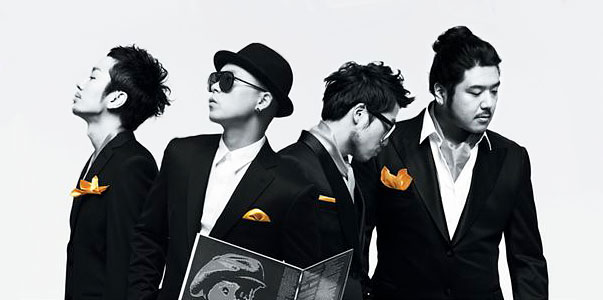
“My Everything” is a track from Brown Eyed Soul’s Soul Free.
Image: “Brown Eyed Soul, Promo (GoKpop),” Hallyu Harmony, accessed August 14, 2014, http://kpop.omeka.net/items/show/250.


“Dance All Night” is a track from g.o.d’s album, Chapter 2.
Image: “g.o.d, Promo (Soompi),” Hallyu Harmony, accessed August 14, 2014, http://kpop.omeka.net/items/show/384.
Beyond the Chinese Connection: Contemporary Afro-Asian Cultural Production was recently reviewed on Asian American Literature Fans. stephenhongsohn wrote:
Crystal S. Anderson’s brilliant monograph, Beyond The Chinese Connection: Contemporary Afro-Asian Cultural Production (University Press of Mississippi, 2013), is on the forefront of the growing trend devoted to comparative race studies and seeks to show the asymmetrical but interconnected ways that racial and ethnic representation appears in popular culture, print, film, and other such media. The book is rigorous and expansive in its scope and sweep.
Read the entire review here!
Crystal Anderson is the author of the book, Beyond The Chinese Connection: Contemporary Afro-Asian Cultural Production. In this study, Anderson explores the cultural and political exchanges between African Americans, Asian Americans, and Asians over the last four decades. She talked about these dynamics at First Mondays at Colorado College in March 2014.

Authenticity is a major theme in scholarship on rhythm and blues (R&B), which poses some interesting challenges for my work on how R&B travels transnationally. Some writers define authenticity in R&B solely in terms of the experiences of African Americans, deeming crossover beyond the black community as pandering to the mainstream (read white people). Others take the hybridity of black music as their starting point and suggest alternative ways of reading the appeal of R&B beyond American blacks. The centrality of music aesthetics as well as audience agency proves most useful for my work.
For some, R&B is defined by its reflection of black life. Nelson George throws down the gauntlet in The Death of Rhythm and Blues when he links R&B to black life that revolves around “a black community forged by common political, economic and geographic conditions” (x-xi). R&B “becomes a sad shell of itself” in the midst of attempts to crossover and appeal to non-blacks: “As a result of these broad social changes [that include assimilation], black culture, and especially R&B music, has atrophied. The music is just not as gutsy, or spirited or tuned into the needs of its core audience as it once was” (xii). For George, R&B’s core audience is black, while the crossover audience is white. But what about other kinds of audiences that have embraced R&B?
However, when R&B is valued for its aesthetic as well as socio-economic value, hybridity challenges such reductive racial authentication. In The New Blue Music: Changes in Rhythm & Blues, 1950-1999, Richard J. Ripani takes issue with George’s perception that “the music had a greater degree of ‘blackness,’ up to the late 1980s, by which time, he believes, that the potential for crossover success by black artists had sapped the music of its African-American cultural strength” (12). Because R&B is a hybrid musical form where “every rhythm & blues song is a blend, more or less, of inherited AFrican and European musical styles. . . . it seems folly to try to determine which have a sufficient degree of a given musical characteristic to be considered ‘real.'” (8). Instead, Ripani identifies elements of the blues system incorporated in the many genres under the umbrella of R&B. Brian Ward complements this approach by focusing on the creativity in the music itself in Just My Soul Responding: Rhythm and Blues, Black Consciousness and Race Relations: “This sort of racial essentialism actually undervalues the dazzling complexity and syncretic brilliance which have characterized black American musical forms in favour of a desperate search for African roots and retentions, as if these comprised the only criteria for evaluating the worth and relevance of contemporary African American music” (11).
Moving the interpretative lens to music aesthetics also allows for a fuller exploration of audiences, and in terms of my work, opens up the way to exploring how black music travels and speaks to non-blacks. Ward recognizes the agency of diverse audiences: “Those meanings were also constructed by individual and collective listeners, sometimes in ways which defied the initial intentions of the artists involved and transcended the economic priorities and racial conventions of the industry within which they worked. Black and white audiences could. . . shape the social and political meanings of musical products by the manner of their consumption” (5).
Focusing on the music, the thing that diverse audiences engage, allows me to understand how black music is embraced in its many forms by K-pop, beyond lyrics. Clearly, there is something in the music that resonates with non-black audiences. Ward and Ripani helps me to work out the meanings of music aesthetics that are embraced by transnational audiences.
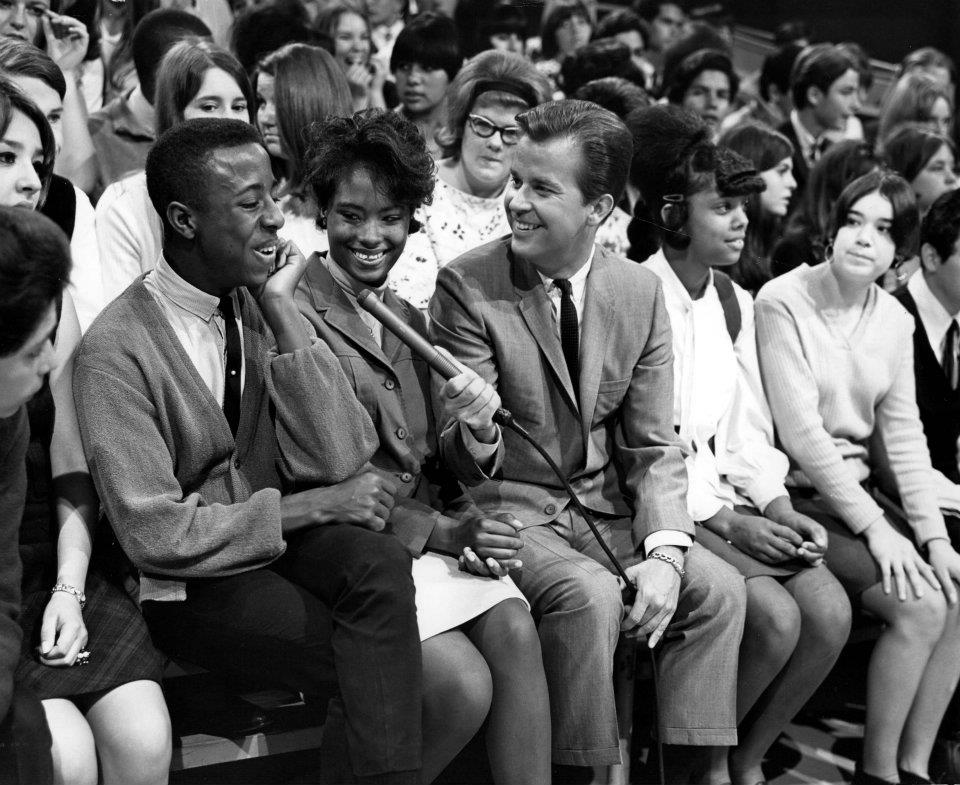
Image: “American Bandstand, 1960s.” Facebook. N.d. Web. 7 Aug 2014.
Sources
George, Nelson. The Death of Rhythm and Blues. New York: Penguin Books, 1988.
Ripani, Richard J. The New Blue Music: Changes in Rhythm and Blues, 1950-1999. Jackson: University of Mississippi Press, 2006.
Ward, Brian. Just My Soul Responding: Rhythm and Blues, Black Consciousness and Race Relations. Berkeley: University of California Press, 1998
My book, Beyond the Chinese Connection: Contemporary Afro-Asian Cultural Production, was recently reviewed in MELUS, Journal for the Society for the Study of the Multi-Ethnic Literature of the United States. Julia Lee writes:
Anderson’s work to connect Lee’s filmic oeuvre with cultural productions of a much later period initially might seem quixotic to literary scholars used to working within strictly defined periods, but to my mind, this represents the project’s greatest strength. Anderson takes seriously Hortense Spillers’s notion of discontinuities, which emphasizes the uneven and fluid nature of ethnic literary histories.
Read the entire review at Project Muse.


Some people think that male K-pop groups are all the same. However, research suggests that fans differ in their attitudes towards individual male K-pop groups. Responses collected from fans of Super Junior and BigBang reveal that they also hold different opinions on their music and group dynamic. Such responses suggest that while some do not distinguish between male K-pop groups, fans do.
Because many male K-pop groups are idol groups, they tend to be painted with the same broad, generalized brush. Sometimes, they are described as being too similar to each other. An editorial in The Korea Times, suggests that people “seem fed up with similar ‘idol’ dance groups cropping up like mushroom[s].”
Other times, they are seen as promoting the same musical style or image. Part of this is attributed to the training program Korean agencies use for idols. Solee I. Shin and Lanu Kim argue that “constant monitoring of the tastes and preferences of the consumers and factoring the successful elements back into the products. . . [make] successful products increasingly predictable and. . . homogenizes the entire domestic music scene.” Nabeela at seoulbeats echoes the concern about groups being the same by speculating about “how much of the content in K-entertainment is standardized and recycled.”
However, a comparison of the responses from fans of Super Junior and BigBang reveals that fans like the groups for different reasons. This data represents a convenience sample collected via an online survey between December 8, 2012 and May 1, 2013. Respondents were asked to explain why they considered themselves a fan of the respective groups. 80 respondents identified themselves as fans of Super Junior, and 119 respondents identified themselves as fans of BigBang. Of these 199 respondents, 95.7% were women and 4.3% were men. Participants were: Asian (42.3%), White (41.2%), Latino (8.4%) and Black (7.9%). They largely hail from the United States, Hungary, United Kingdom, Philippines and Australia. Respondents range in age: 32.6% were 16-18, 31.6% were 18-21, 12.8% were 22-25, 14.4% were 25-30 and 8.6% were 30 and over. This data was analyzed using phenomenological methods.
Music
Both fandoms cite music as a major factor in the appeal of the groups, but Super Junior fans liked the upbeat nature of the music, while BigBang fans valued the edgy and unique nature of the group’s music.
Super Junior fans like the cheerful nature of the music. One respondent noted: “I can listen to their songs any time even if I sad or depressed” (Anderson). Another stated: “Their music always makes me smile no matter how depressed I am” (Anderson). Super Junior fans also cited the pop-oriented style that the group reflects, as well as a range of styles. One respondent wrote: “Their music has gone from happy, bubbly pop to funky dance tracks” (Anderson).
Reviews of Super Junior albums reveal that the group is generally known for pop-oriented fare that also ranges across genres. Jung Bae describes their 2012 release, Mr. Simple, as “cleanly divided into club/dance and pop ballad(s),” where singles like “Opera” are “a standout, paced by an intoxicating stutter beat and a sublime sense of kinetic energy throughout.” Emily Wu references the “Super Junior Funky Style” in her review of the album: “It contains a catchy and addicting tune and melody that is sure to grab your attention from the get-go.”
BigBang fans focused more on the unique nature of the music. Some cited the specific genre of hip-hop as a major reason for the appeal of the group. One respondent noted: “Their style of music is what I enjoy most in American music, even if I don’t listen to American music as much anymore. Hip hop and R&B were genres that I grew up on but then it started changing too much for me. But Big Bang has a style to them that makes me love the genre all over again” (Anderson). Such opinions dovetail into another theme that emerged from the responses, namely, the unique nature of the group in respect to BigBang’s music. One respondent noted: “Their music caught me when I first listened to it and it is nice to listen to whenever I want to something different then the usual Kpop” (Anderson). Another noted: “Their music is distinguishable and stands out amist all of Kpop” (Anderson). BigBang has a reputation for being more adventurous in terms of their music.
Ashleigh Gregory describes the 2011 album Alive as partaking in a range of genres: “This album combines a variety of safe, pop style songs and pairs them up with slightly more experimental electro sounding tracks that create a great mix and leaves you wanting to replay the album as soon as it’s done.” Such eclecticism makes its way into their live shows as well. Jon Caramanica writes: “The band wove an interpolation of the signature guitar crunch of Nirvana’s “Smells Like Teen Spirit” into a song. Multiple members of the group beatbox, a technique that’s hardly, if ever, used in mainstream American hip-hop, its birthplace, but is a routine part of the K-pop star arsenal.”
Group Dynamic
Both fandoms cite group dynamic as another major factor in the appeal of the groups, but Super Junior fans describe that dynamic in terms of cooperation and a close-knit bond, while BigBang fans focus on the individual members’ contribution to the group.

Despite the large number of members, Super Junior fans described the group as close-knit. Some respondents focused on how they act as one or a team. One respondent noted: “They have their own personality but still can be one” (Anderson). Another wrote: “Not typical boyband material. They have a strong bond despite being a huge group” (Anderson). Other respondents focused on the close bond between members and several used the metaphor of family. One wrote: “Watching their bond as a group really influenced me. Seeing how they trust each other. I can feel and see their brotherly love, how they care about each other” (Anderson). Another wrote: “Super Junior are a big group because they have lots of members but despite that they all get along like a family” (Anderson). Another responded: “What I really like from them is their close relationship with each other. They are truly like a family, they’re like brothers” (Anderson).
This may be related to fans watching Super Junior’s participation in extra-musical activities in the form of television and radio appearances. Members of Super Junior hosted and/or starred in the Korean variety show Strong Heart from 2009-2012 and the radio show Kiss the Radio from 2006 to the present. In these spaces, fans develop opinions about the dynamic between the members. One respondent wrote: “I understand and love that they’re an entertainment group with members doing radio shows, acting, variety shows and hosting! This has given me the chance to get to know them through many mediums and it’s reassuring to know that at least a few members are still active during their non-promotional period!” (Anderson). In addition to scripted shows, Super Junior also appears on variety shows, which are often based on improvisation and require more participation. One respondent noted: “I didn’t actually like Super Junior much at first, but I kept watching them on variety shows that I liked and the SJ members were always making me laugh so much” (Anderson).

While fans of BigBang cite group dynamic as part of the appeal of the group, they focus on the individual members within the group. Most respondents focused on the unique nature of the individual members. One wrote: “I also like how distinct the members are from each other” (Anderson). Another said: “Each member has their own talents and strengths when it comes to vocally and lyric writing and Big Bang along with YG utilizes that talent extremely well” (Anderson). Still another wrote: “Each of the members have very different but equally interesting styles from their style of singing to the dancing” (Anderson). Others cited individual members as part of their reason for liking the group. Of these responses, the largest number cited G-Dragon as their reason for liking the group. One respondent noted: “G-Dragon has also been very successful on his own drawing me into the group as a whole” (Anderson). Another noted: “G-Dragon is probably one of the reasons why I like Big Bang so much. I like the music he produces and I appreciate that a lot since not all groups produce their own music. The fact that someone from the group produces their own music is pretty awesome” (Anderson).
Fans of Super Junior like the group because they are traditional idol group. They like the pop nature of their music. They value the camaraderie they see within the group as a result of television and radio appearances. In contrast, fans of BigBang like the group because they challenge this notion of a traditional idol group. Despite being the product of the same kind of training system that produced Super Junior, they see the group as more innovative and creative in their music. They perceive the group as a collection of individuals rather than a cohesive unit. Because of the fewer number of television appearances, their fans may not develop the same kind of sense of camaraderie among the group.
Fans of Super Junior and BigBang represent just two individual K-pop fandoms, but this comparison suggests that fans do not view male K-pop groups in the same way.
Video
“BIGBANG – FANTASTIC BABY M/V.” 6 Mar 2012. YouTube. Web. 19 Dec 2013.
“Super Junior 슈퍼주니어_Mr.Simple_MUSICVIDEO.” 3 Aug 2011. YouTube. Web. 19 Dec 2013.
Sources
Anderson, Crystal. “Super Junior/BigBang Data Set.” Unpublished raw data.
Bae, Jung. “Album Review: Super Junior – Mr. Simple” hellokpop. 12 Aug 2011. Web. 19 Dec 2013.
Caramanica, Jon. “BigBang Performs at the Prudential Center.” The New York Times. 9 Nov 2012.
Gregory, Ashleigh. “[UnitedKpop K-pop Album Review] March: BigBang – Alive.” UnitedKpop. 26 Mar 2012.
Nabeela. “Does Hallyu Only Have a Short Time Left on a Global Stage?” seoulbeats. 27 May 2012. Web. 19 Dec 2013.
Shin, Solee I. and Lanu Kim. “Organizing K-pop: Emergence and Market Making of Large Korean Entertainment Houses, 1980-2010.” East Asia (December 2013): doi 10.1007/s12140-013-9200-0.
“Will ‘Hallyu’ Last Long?” The Korea Times. 10 Aug 2012. Web. 19 Dec 2013.
Wu, Emily. “Album Review: Super Junior – Mr. Simple. ” Ningin (blog). 2 Aug 2011. Web. 19 Dec 2013.

Bring The Boys Out!: Fan Attitudes on Male Kpop Groups Differ by Crystal S. Anderson is licensed under a Creative Commons Attribution-NonCommercial-ShareAlike 4.0 International License. Originally published on KPK: Kpop Kollective on December 19, 2013.
September 25, 2014 ♦ Association for the Study of African American Life and History (ASALH)
Memphis, TN
In 2013, Suey Park organized a Twitter conversation around the hashtag #BlackPowerYellowPeril to “discuss ways in which the Asian American community could work with the African American community to further similar anti-racist, anti-sexist goals.” The ensuing dialogue on Twitter and on other social media outlets focused on “Asian Privilege” and “Asian Anti-Black Racism.” While these are salient aspects of Afro-Asian interaction in the United States, they do not reflect the comprehensive and often contradictory dynamics between African Americans and various Asian and Asian American groups within and outside the United States. This paper uses Bruce Lee’s Enter the Dragon as a lens through which to explore representations of Afro-Asian connections in 1970s film. Produced at the height of the black exploitation film era, the film creates some of the most iconic images of Afro-Asian cultural exchange. Casting Jim Kelly alongside Bruce Lee as potential allies against forces characterized as white and colonial gestures towards the potential for solidarity between African Americans and Asians. Jim Kelly’s character also alludes to the black radical tradition, where black intellectuals and activists frequently rely on the experiences of Asian and Asian Americans to contemplate the future of African Americans. By using both the United States and Hong Kong as backdrops, the film introduces the importance of the transnational in the consideration of Afro-Asian cultural exchange during this time. At the same time, the film reinforces stereotypes of black masculinity and black radical politics, painting both in very limited ways. Even with these more problematic aspects of representation, the film nevertheless demonstrates a foundation for contemporary discussions Afro-Asian connections.


As you know, iFans: Mapping Kpop’s International Fandom is a study seeking to understand the attitudes of global fans of K-pop’s most successful groups. You can now view the results of the analysis of the survey data and an email interview with a fan of SNSD! Click here to view the What Fans Think section of the digital exhibit. Sad that you aren’t included? You can always take the email survey online here! C’mon, SONES, you are one of the biggest K-pop fandoms out there! Click the link and represent!


The 1960s girl group concept makes regular appearances in K-pop. While some think that this kind of image represents a lack of ethnic identity in a quest for mainstream acceptance, I suggest that the 1960s girl group image promoted by women of color represents an ethnic glamour aesthetic.
Contemporary K-pop is driven by image as well as music. Part of this has to do with its emergence along with rising technologies like the music video and the Internet, which “generate[d] a condition of possibility of reaching a mass audience outside of national borders,” and resulted in photogenic performers as part of appealing images (Lie, 353, 356). This is similar to rhythm and blues-inflected pop music of the 1960s. Gerald Early notes that technology contributed to this music becoming an “artifact,” in part because television distributed the music as well as an image (60, 62).
K-pop agencies, like SM Entertainment, carefully craft the images of K-pop artists for concepts. This is part of the training process, which also includes language instruction, choreography and hosting practice. This also contributes to criticisms that such preening in the quest for audience acceptance diminishes the presence of ethnic culture. John Lie argues that contemporary K-pop lacks Korean culture: “As a matter of traditional culture, there is almost nothing ‘Korean’ about K-pop” (360). Motown acts under Berry Gordy also received similar kinds of training and, were subject to similar criticisms. Nelson George defines Gordy’s project as assimilationist in nature, where “white values were held up as primary role models” and as a result, “blacks lost contact with the uniqueness of their people, and with their own heritage” (xii). For George and Lie, mainstream appeal translates into a loss of ethnic culture.
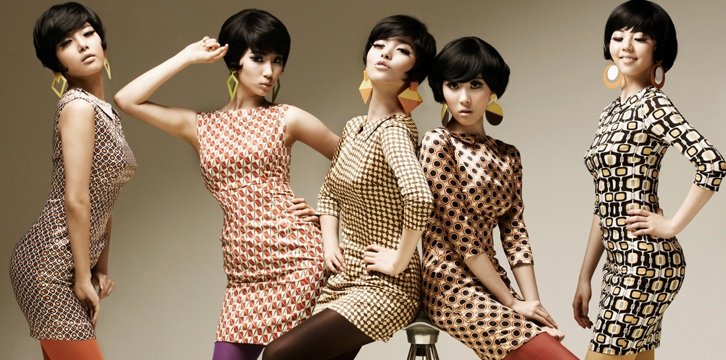
When K-pop adopts the 1960s retro look for female artists through chic hairstyles and dresses with eye-catching prints or dazzling sequins and fur reminiscent of The Supremes, I suggest that it partakes of a model of ethnic glamour established by black girl groups. Brian Ward characterizes Gordy’s quest for mainstream success as one predicated on challenging prevailing notions about American blacks: “Gordy felt [the training] might make them more acceptable to white America and an expanding black middle class for whom mainstream notions of respectability remained important” (266). The aspiration was felt by blacks, even those not in the middle class: “The spangled pursuit of success carried no stigma among black fans who had routinely been denied equal opportunity to compete for the financial rewards of the mainstream” (Ward, 267). This is key, because it shows the importance of how viewers read such images. Cynthia Cyrus argues that even though the images of girl groups of the 1960s were well-managed and carefully crafted, they nevertheless resonated positively with fans: “The girl group images offer affirmative messages about what it means to be female, messages about belonging, about possibilities for participation, about the possibility of success. . . . The role of the viewer is central to creating meaning, and the girl group fan engaged actively in dialogue with the images placed before here” (190-1).
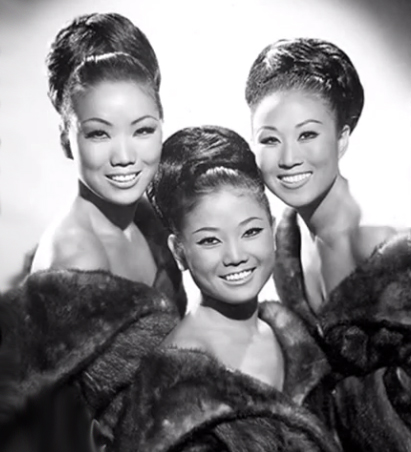
Just as black fans interpreted those images of black women as positive, Korean women like the Kim Sisters, styled in the same way, represent a glamourous ethnic, in this case, Korean, experience to aspire to. Ian Kim writes: “For a Korean American like me, who grew up in parts of the US where I was the only Asian kid in school, it’s pretty astonishing to discover Korean performers who were successful in the US such an early time. Even more impressive is that they sang in English.” The Kim Sisters’ images and participation in the entertainment world in the United States functioned as an alternative to the realities of the aftereffects of the Korean War and American military presence. San Byun-Ho remembers: “After the Korean War, the Korean situation was the worst in the world; we were one of the poorest countries, like the Congo or somewhere like that. The country was devastated. A lot of people died” (Forsyth). Just like images of 1960s black girl groups, such images of the Kim Sisters represent an image of ethnic aspiration.
Contemporary fans may see retro images in K-pop, like those by Lee Hyori and the Wonder Girls, as drawing from a visual discourse of ethnic glamour. The measure of the impact of the image should also be measured by those who make meaning out of it. These images matter precisely because they show Koreans in a glamorous context that also acknowledges their ethnicity. As the Vintage Black Glamour Tumblr and forthcoming book suggest, images of ethnic glamour still resonate today. Nichelle Gainer says that any image she chooses has to have “a certain style to it, a certain beauty” and that she includes information about the photo because “I want people to know you’re not looking at some anonymous random person” (Brown). Given the frequency that the 1960s concept recurs in K-pop, ethnic glamour still matters.
Sources
Brown, Tanya Ballard. “‘Vintage Black Glamour’ Exposes Little-Known Cultural History.” The Picture Show – Photo Stories from NPR. NPR . 12 Oct 2012. Web. 27 Jan 2014.
Cyrus, Cynthia J. “Selling an Image: Girl Groups of the 1960s.” Popular Music 22.2 (2003): 173-193.
Early, Gerald. One Nation Under a Grove: Motown and American Culture. Ann Arbor: University of Michigan Press, 2012.
Forsyth, Luc. “Korea’s Stressed Masses.” Groove Korea. 20 Aug 2012. Web. 27 Jan 2014.
Kim, Ian. “The Kim Sisters.” Ian Kim. 23 Jan 2014. Web. 28 Jan 2014.
Lie, John. “What is the K in K-pop?: South Korean Popular Music, the Culture Industry, and National Identity.” Korea Observer 43.3 (2012): 339-363.

Ethnicity, Glamour and Image in Korean Popular Music by Crystal S. Anderson is licensed under a Creative Commons Attribution-NonCommercial 4.0 International License. Originally published on KPK: Kpop Kollective on January 28, 2014.
 csaphd | Crystal S. Anderson